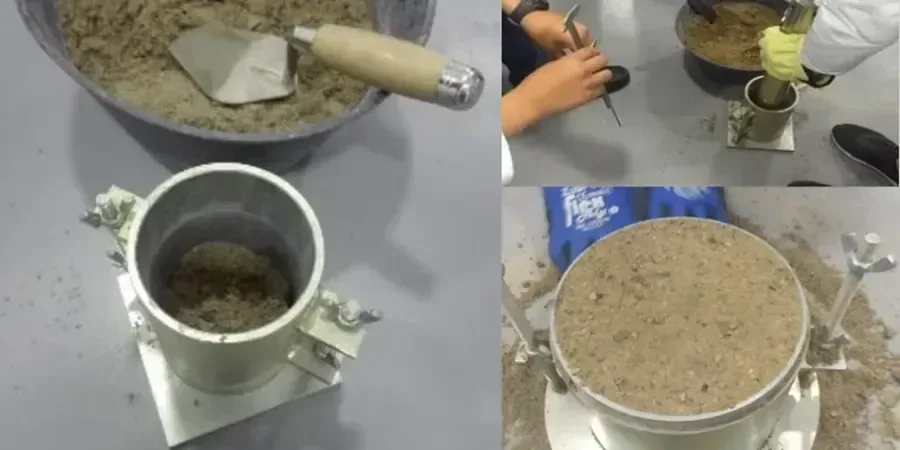
Paving a parking lot near the Lehigh River, we saw a contractor struggle with subgrade settlement on a 10,000-sf site. The engineered fill had been placed without proper moisture-density control. We ran a modified Proctor test to establish the target dry density and optimum moisture content for that specific borrow material. The correction saved the project from a full recompact and slab crack repair. In Allentown, where glacial till and alluvial silts alternate beneath the same block, a generic compaction curve from a state manual is not enough. Our lab calibrates each Proctor test to the actual soil blend on your site. For fills that must support heavy loads, we combine this data with a plate load test to verify achieved stiffness in the field.
A generic Proctor curve from a state manual can lead to loose fills that settle under load; site-specific testing is the only way to ensure long-term performance.
Method and coverage
The Proctor test in our Allentown facility uses a 5.5-lb rammer dropped 12 inches for the standard method (ASTM D698) and a 10-lb rammer at 18 inches for the modified version (ASTM D1557). We compact the soil in three to five layers inside a 4-inch or 6-inch mold, depending on particle size. The test requires about 20 pounds of representative material, which we sieve through a No. 4 screen for the standard procedure. For soils with gravel, we use the modified Proctor with oversize correction per ASTM D4718. Every curve we produce includes the 100% saturation line so you can see how close your field density comes to the theoretical maximum. Before testing, we log the soil's natural moisture and run a gradation analysis to ensure the sample matches the bulk material from your Allentown excavation.
Technical reference image — Allentown
Regional considerations
Compare two Allentown neighborhoods: the West End, built on well-drained glacial till, and the riverfront near the Lehigh, underlain by soft alluvial silts. A Proctor test on the till will yield a dry density near 130 pcf with low sensitivity to moisture variation. On the alluvial soil, the same Proctor curve shows a steep drop in density once moisture exceeds optimum by just 2%. Contractors who skip a site-specific Proctor for the riverfront area risk placing fill that is too wet, leading to pumping during compaction and eventual settlement under pavement. We have seen this pattern repeat on warehouse sites along the I-78 corridor. Without the correct optimum moisture target, no amount of roller passes fixes a soil that is already above its Proctor optimum.
For general fills, subgrades, and residential earthwork where compaction effort is moderate. Uses a 5.5-lb hammer and 12-inch drop. Best for silts, clays, and fine sands. Typical turnaround is 2 business days from sample receipt.
02
Modified Proctor (ASTM D1557)
For highway embankments, heavy industrial slabs, and structural fills requiring high density. Uses a 10-lb hammer with 18-inch drop. Includes oversize correction for gravelly soils. Results include zero-air-voids curve for field comparison.
What is the difference between Standard and Modified Proctor tests?
The difference is in the compaction energy applied. Standard Proctor uses a 5.5-lb hammer dropped 12 inches with 25 blows per layer, while Modified Proctor uses a 10-lb hammer dropped 18 inches with the same blow count. Modified Proctor applies about 4.5 times more energy, producing a higher maximum dry density and lower optimum moisture content. For heavy-traffic pavements or deep fills, Modified Proctor is usually required; for residential subgrades, Standard is sufficient.
How much does a Proctor test cost in Allentown?
A Standard Proctor test typically runs between $100 and $150, while a Modified Proctor costs between $150 and $200. The price may increase if oversize correction or multiple moisture points are needed. We provide a firm quote after reviewing the soil type and number of samples. Volume discounts apply for projects with more than five tests.
Do I need a Proctor test for every soil type on my site?
Yes, if you encounter more than one distinct soil type. Allentown's glacial till and alluvial soils have very different compaction characteristics. Using a single Proctor curve for both can lead to undercompacted fill in the alluvial zones. We recommend at least one test per soil unit, and a separate test for any imported borrow material. The IBC and local building officials often request this level of detail for commercial permits.
How long does the Proctor test take, and when do I get results?
The laboratory procedure itself takes about 24 hours, including sample preparation, compaction, and oven drying. We typically deliver the full compaction curve and report within 2 business days after receiving the sample. For urgent projects, we can expedite to next-day delivery for an additional fee. The report includes the optimum moisture content, maximum dry density, and the zero-air-voids curve.