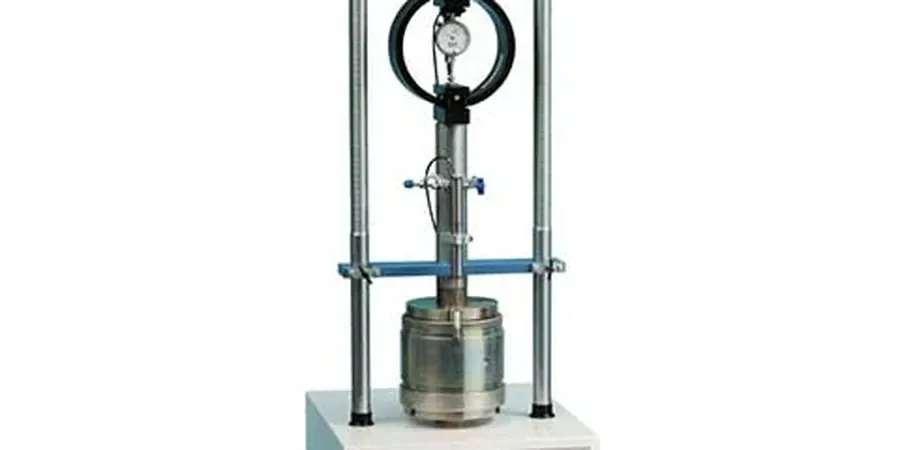
Allentown sits in the Lehigh Valley, where freeze-thaw cycles and seasonal rainfall dominate the climate. The soil profile here shifts from sandy loam near the river terraces to stiff glacial till on the higher ground. That variability means a single assumed CBR value can lead to either an overbuilt pavement — wasting tens of thousands in concrete and asphalt — or one that fails within two winters. We run soaked and unsoaked CBR tests on undisturbed and recompacted samples to capture the worst-case moisture scenario. For projects on the South Side or near the Little Lehigh Creek, where groundwater sits close to the surface, we often combine this test with a permeability field test to check drainage conditions before finalizing the design subgrade modulus.
A single point CBR test on the wrong layer can underestimate subgrade strength by 40% — we sample every soil horizon separately.
Method and coverage
We follow ASTM D1883-21 for every CBR study in Allentown, and we calibrate the laboratory load penetration curves against the site-specific moisture-density relationship from the Proctor test. The city's zoning includes both industrial corridors (Route 22, Airport Road) and residential subdivisions in older neighborhoods like West End and Center City. Each demands a different design traffic index, and the CBR value directly governs the required pavement layer thickness under AASHTO 1993 or the new mechanistic-empirical MEPDG method. Our team prepares specimens at OMC and at 95% of maximum dry density, then soaks them for 96 hours to simulate spring-thaw saturation. The
Two-point CBR correlation for preliminary estimates
Multi-point CBR on recompacted samples for structural sections
Field in-situ CBR using a dynamic cone penetrometer (DCP) for quick checks during earthworks
These protocols give the design engineer a defensible number for the subgrade reaction modulus (k-value) or resilient modulus (Mr), which is what the pavement design software actually needs.
Technical reference image — Allentown
Regional considerations
Between the historic fill along the Lehigh River and the stiff residual soils near the Blue Mountain ridge, Allentown's subgrade varies block by block. A CBR value of 8 in the sandy terrace material can drop to 3 or 4 in the clay-rich glacial till after a wet spring. The biggest risk we see is contractors taking a single CBR from a test pit and applying it to the entire road alignment — that shortcut guarantees differential settlement at utility trench crossings and premature fatigue cracking in the asphalt. That is why we run at least three CBR tests per soil unit along every 500-foot segment of the proposed road.
Standard ASTM D1883-21 on undisturbed tube samples or recompacted specimens prepared at OMC and 95% MDD. Includes 4-day soak period, swell measurement, and load-penetration curve. Final report provides CBR at 0.1 in and 0.2 in, plus correlated resilient modulus (Mr) for pavement design software.
02
Field CBR / DCP Survey for Earthwork Verification
In-situ dynamic cone penetrometer (DCP) testing at 50-ft intervals along the proposed alignment during subgrade preparation. Correlates directly to CBR using the Webster method. Useful for proof-rolling verification and identifying soft spots before paving. Results delivered within 24 hours.
This service complements our laboratory testing work for a complete project analysis.
Standards that apply
ASTM D1883-21 (CBR test procedure), AASHTO T 193 (CBR of compacted soils), IBC 2021 (Chapter 18 for soil classification and subgrade evaluation), AASHTO 1993 / MEPDG (pavement design guides)
Quick answers
How many CBR tests are needed for a typical Allentown residential street?
For a 1,500-foot local road with uniform geology, we recommend a minimum of three laboratory CBR tests — one per soil horizon encountered in the test pits. If the alignment crosses the transition between river terrace and glacial till, add two more tests to capture the variation. In practice, most subdivision projects in Allentown require between three and six CBR tests.
What is the cost range for a CBR study in Allentown?
The typical cost for a complete CBR study in Allentown ranges between US$190 and US$300 per test point, including sample preparation, 96-hour soak, penetration testing, and a full report with Mr correlation. Final price depends on the number of samples, access conditions, and whether field DCP verification is included.
Does Allentown's freeze-thaw climate affect the CBR value I should use for design?
Yes. The soaked CBR value (after 96 hours of submersion) mimics the worst-case spring-thaw condition when the subgrade is weakest. For Allentown, where frost penetrates 30–36 inches, we always report the soaked CBR as the design value. The unsoaked CBR might be 50% higher, but using it would result in a pavement that cracks after the first freeze cycle.
Location and service area
We serve projects across Allentown and its metropolitan area.