Allentown's geology is a mix of glacial till, alluvial deposits along the Lehigh River, and residual soils from weathered sedimentary rock. That variety means contractors often find themselves dealing with high-plasticity clays or loose silty sands that simply won't compact to spec. Lime and cement stabilization is the go-to solution for modifying the engineering properties of these problematic soils. The process—quicklime or Portland cement mixed in at 3 to 8 percent by dry weight—reduces plasticity index, increases California Bearing Ratio (CBR), and cuts swelling potential. Before starting any stabilization design, the team typically runs a classification of soils to identify the exact mineralogy and particle-size distribution that will dictate the additive dosage. That step saves time and material on site.
For Allentown's glacial tills and river silts, lime cuts plasticity while cement delivers early strength—each additive has a specific window to work.
Method and coverage
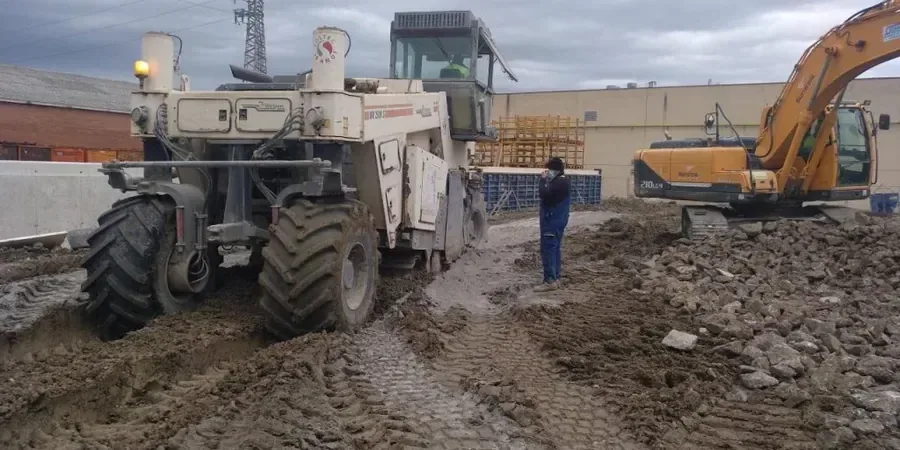
On a typical Allentown job, the contractor brings in a rotary mixer or a reclaimer/stabilizer to blend the dry or slurry additive into the existing subgrade to a depth of 12 to 24 inches. The mixing must achieve uniform distribution—pockets of untreated soil will create weak zones later. After mixing, the material is compacted at or near optimum moisture content per ASTM D698 (Standard Proctor) and then cured for 3 to 7 days. For cement stabilization, the team monitors the set time closely because once hydration starts, you cannot rework the material. For lime treatment, a mellowing period of 24 to 48 hours is often allowed before final compaction. A field plate load test then verifies that the modulus of subgrade reaction meets project specifications before any pavement or slab placement.
Technical reference image — Allentown
Regional considerations
Allentown expanded rapidly in the post-war decades, with residential developments pushing into marginal floodplains and old quarry fills. Much of that infrastructure now sits on subgrades that were never treated. The risk shows up as longitudinal cracking in road pavements, differential settlement in slab-on-grade foundations, and heave in areas with high-sulfate clays where lime treatment was either skipped or improperly designed. When sulfates in the soil react with lime, ettringite forms and causes expansion—a hidden failure that can crack a pavement within two years. A proper geochemical assessment, including soluble sulfate testing, is required before any stabilization design in Allentown to avoid this reaction.
Designed for high-PI clays common in Allentown's glacial till deposits. Quicklime or hydrated lime is applied at 4-6% dry weight to reduce plasticity, improve workability, and provide a stable working platform. Includes pH testing (ASTM D6276) to verify the lime fixation point and field compaction control.
02
Cement Stabilization for Granular Soils and Base Course
Portland cement (Type I/II) blended at 3-7% dry weight for silty sands and low-plasticity soils. Produces a cemented slab with unconfined compressive strengths of 200-600 psi in 7 days. Used for subbase improvement, pavement subgrade correction, and temporary access roads. Includes Proctor compaction and UCS cylinders per ASTM D1633.
Standards that apply
ASTM D6276 – Standard Test Method for Using pH to Estimate the Soil-Lime Proportion, ASTM D4609 – Standard Guide for Evaluating Effectiveness of Admixtures for Soil Stabilization, ASTM D1633 – Standard Test Methods for Compressive Strength of Molded Soil-Cement Cylinders, IBC 2021 – Chapter 18 (Soils and Foundations) for stabilized subgrade acceptance
Quick answers
How do I decide between lime and cement for my Allentown project?
Lime is the better choice when the soil has a plasticity index above 15 or contains expansive clays; it modifies the clay structure permanently. Cement works best for low-plasticity silts and sands where you need rapid strength gain—often within 24 to 48 hours. The deciding factor is the soil's Atterberg limits and the project schedule. A preliminary classification test is always run first.
What is the typical cost range for lime and cement stabilization in Allentown?
For a standard road or slab subgrade project in Allentown, the cost including materials, mixing, compaction, and quality control typically falls between US$750 and US$2.660 per 1,000 square feet. The exact figure depends on treatment depth, additive dosage, and whether sulfates require a special binder. A site visit and soil analysis are needed for a firm quote.
Can stabilization be done in wet weather or on saturated subgrades?
Lime can help dry out a wet subgrade by consuming water during the hydration reaction, but cement requires the soil to be within 2% of optimum moisture. Working in Allentown's humid summers means the crew must time the mixing and compaction within a narrow window—usually early morning before the dew point rises. Heavy rain within 4 hours of mixing can ruin the treated layer.
How is the long-term performance of stabilized soil verified?
The standard verification includes 7-day and 28-day unconfined compressive strength tests on molded cylinders, field density checks with a nuclear gauge, and a final plate load test on the finished layer. For lime-treated soils, the pH is rechecked after 48 hours to confirm the reaction is complete. We also recommend a sulfate test if the subgrade shows any gray or bluish clay.